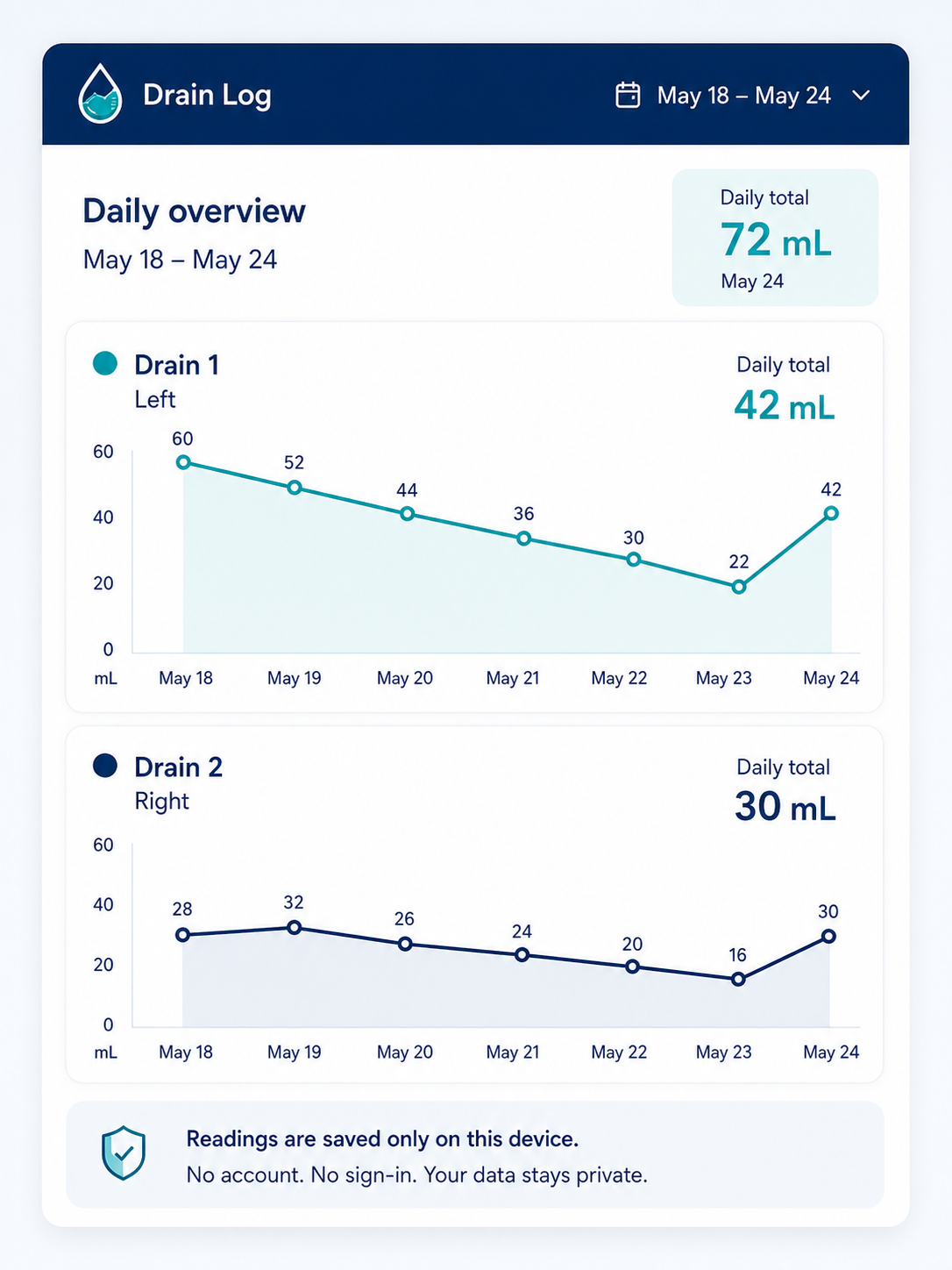
Record the lymphatic fluid from each postoperative drain after emptying it. Your data stays on this device.
🔒 Local only
At a glance
Today's totals
0 mL
Latest
Today's readings
Your records
History
Readings are grouped and totaled by day.
Care team
Doctor report
Create a clean report of your recorded lymphatic drainage.
Ready to share
Report preview
Open the downloaded PDF in your browser or PDF viewer, then select Print.
Recovery library
Education
General information to help you understand postoperative lymphatic drainage. It is not individualized medical or nutrition advice.
Understanding your drain
What is postoperative lymphatic drainage?
After breast or lymph-node surgery, blood, lymphatic fluid, and other healing fluids can collect near the surgical area. A surgical drain uses a small tube and collection bulb to move this fluid away while the area heals.
The amount usually changes during recovery. Your surgical team decides when a drain can be removed based on your procedure, measurements, and clinical assessment.
Surgical drainage is not the same as lymphedema. Lymphedema is swelling caused by impaired lymph flow and may affect the arm, hand, breast, or chest after lymph-node surgery or radiation.
Tracking
Why measure each drain?
A dated record helps the care team see how output changes over time. Record the amount after emptying the bulb, identify which drain it came from, and use the same measurement method each time.
Empty and measure at the schedule provided by your care team.
Keep the bulb compressed if instructed so it maintains suction.
Do not pull, cut, flush, or remove a drain unless your care team directs you.
Contact the surgical team about fever, increasing redness or swelling, pus-like or foul-smelling fluid, sudden unexpected changes, loss of suction, or a displaced tube.
Food and healing
Nutrition during recovery
No particular food has been proven to “flush” the lymphatic system or directly control surgical-drain output. Food supports recovery by supplying energy, protein, vitamins, minerals, and fluids needed for healing.
Include a protein source such as eggs, fish, poultry, beans, tofu, yogurt, or another option appropriate for you.
Choose a balanced variety of fruits, vegetables, and whole grains as tolerated.
Drink adequate non-alcoholic fluids unless your clinician has restricted fluids.
Do not begin supplements, herbal products, or a restrictive diet for drainage without discussing them with the care team.
People with diabetes, kidney or heart disease, swallowing problems, allergies, nausea, poor appetite, or unintended weight loss should seek individualized advice from their clinician or a registered dietitian.
Know the difference
What is lymphedema?
Lymphedema is persistent swelling that can occur when lymph nodes or vessels are removed, damaged, or affected by radiation. It is different from fluid collected by a temporary surgical drain.
Tell your care team about new or worsening swelling, heaviness, tightness, reduced movement, skin changes, or discomfort in the arm, hand, breast, or chest. Early assessment can help identify the cause and appropriate care.
Preferences
Settings
Drain Log Plus
One-time report tools unlock
Unlock printable PDF reports and JSON data export with one payment.
$4.99
Payment and account details remain separate from lymphatic drainage readings and notes. Report tools will only be restricted after secure payment verification is configured.
Our story
Why Drain Log was created
Drain Log was inspired by a personal experience.
After my wife was diagnosed with stage 1 breast cancer and underwent surgery, we were given several sheets of paper to record her surgical drain output manually. During an already stressful recovery, keeping track of measurements, dates, times, and daily totals on paper felt unnecessarily difficult and inconvenient.
I created Drain Log to offer patients and caregivers a simpler way to record postoperative lymphatic drainage, follow changes over time, and prepare a clear report for their care team.
My hope is that Drain Log makes one small part of recovery easier, more organized, and less stressful for other patients and families.
Drain Log is a recording and educational tool. It does not provide medical advice, diagnosis, or treatment. Always follow the instructions of your own surgical and oncology teams.
Developed by Creative AI Solutions LLC www.caisolutionsllc.com
Your local data
Deleting browser data or removing the app can erase these records.